RVs For Sale in California Thousands of RVs for Sale, New, Used by Dealers and Private Sellers

Wednesday, February 15, 2012

In war of words, is it "Wal-Mart State Parks"?

In a move which one critic said would constitute turning state parks over to Wal-Mart, a California oversight board has approved a plan that could allow profit making companies to take over operations of some of California's beleaguered parks.

In a story carried by the Press Democrat, earlier this month the California Public Works Board approved a plan to put 11 state parks out for competitive bids for some operations by private business. Included in the proposal were Sugarloaf Ridge State Park and Austin Creek State Recreation Area. Bundling these two along with nine other parks would make them more attractive to bidders. Since the approval it appears Sugarloaf Ridge has come out of the package, as a non-profit group has stepped forward with plans to operate the park.

For the other parks, concession operation could mean operating restaurants, day use facilities, and even campgrounds. While the state claims it has authority to turn over entire park operations to private concessionaires, it says it would rather look into "hybrid" operations, where non-profits would manage some park operations and winning bidders take on the balance.

The problem with that approach, say critics, is that the private firms would vacuum up the profitable sides of parks, campground operations for example, and leave the non-profits holding the bag, attempting to run their portion of the parks with limited or non-existed park-generated funding.

California State Parks are in a funding crisis, and 66 parks are on a list to be closed come July 1. Having the sword hanging over these parks has kept the nerves of all concerned open to the air. In late January a state parks spokesman said that the agency could give thought to allowing private concerns rights to operate entire parks. Opposition groups and individuals reacted quickly, including Senator Noreen Evans, a Santa Rosa Democrat. Evans predicted a "Wal-Mart State Park and Recreation System."

As time rushes on toward the closure deadline the war of words will likely get hotter.

photo: Sugarloaf Ridge SP, California State Parks

Monday, February 13, 2012

Northern elephant seals find love in coastal California rookeries

Wildlife watching is one of the pleasures of RV touring, where you can see completely different animals and birds as you wander to different regions of the country.

The national parks are prime sources for viewing wildlife, since they are protected and have gotten used to human presence. In Yellowstone you can see bison, elk, black and grizzly bears, and if you're lucky, grey wolves.

Mountain goats and bighorn sheep hang out in Logan Pass in Glacier, and you can watch California condors soar on their 9-foot wingspans over the Grand Canyon.

In California, elephant seals that had once been hunted almost to distinction, have seen their population increase dramatically. Most of the seal rookeries are on islands off the West coast from Vancouver Island to Baja California where an estimated 120,000 to 150,000 breed. This enormusly successful recovery was made possible by the outlawing of fur seal hunting in 1922--increasing from only about 125 animals in 1911.

Seals spend eight to ten months a year in the open ocean, diving 1000 to 5000 feet deep for periods of fifteen minutes to two hours, and migrating thousands of miles, twice a year, to their land based rookeries for birthing, breeding, molting, and rest. They are most active from December through March at the rookeries. 

But you don't have to travel to offshore islands to see these magnificent animals--adult males grow to lengths of 15 to 18 feet long and weights of 3,600 to 5,400 pounds--there are mainland rookeries where the seals can now be found. And there are campgrounds, both private and in State Parks, within close proximity of the rookeries.

The oldest mainland rookery and most widely known, Ano Nuevo State Park north of Santa Cruz on Route 1, is a major and accessable rookery. Guided tours are available and access is limited and requires a reservation most of the time when the seals are active.

In recent years the seal rookery at Piedras Blancas, on California highway 1 at the southern end of Big Sur seven miles north of San Simeon and four miles north of the entrance to the Hearst Castle, has seen its population explode to an estimated 17,000 animals. A main viewing area is open for viewing every day of the year, there is no admission fee or reservation required, and the parking lot will accommodate big rigs with plenty of turn around space.

The location is ideal for the seals: it is protected by the Piedras Blancas point from storms from the northwest; it has wide, sandy beaches offering pups protection from high water; and it is protected from predators by a kelp forest.

Another mainland rookery can be found at Point Reyes National Seashore where the first female gave birth to a single pup in 1981. About 700 seals litter the Point Reyes beaches and 200 pups have already been born with more likely. Last Winter and Spring 600 pups were born at the rookery.

You can learn more about elephant seals here or watch a video of the seals at Piedras Blancas.

Thursday, February 9, 2012

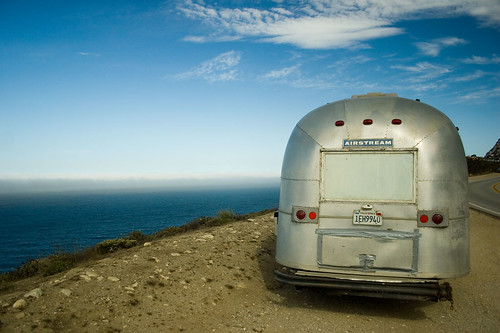
In Sonoma, find a bit of travel trailer history

When in northern California, you may want to stop by Kevin O'Connell's place to take in a good gaze of RV history. No, O'Connell doesn't run an RV museum -- he runs an RV restoration shop. 
 
Tucked away in the scenic Russian River Valley in colorful Sonoma County, it only seems natural that the shop would be here. The town has a sort-of "Route 66" feel to it. If Barney Fife gave you a parking ticket, you wouldn't be a bit surprised.

Kevin O'Connell describes himself as a "detail freak," a man who puts whatever amount of time he feels needed to bring back the real feeling of the rigs he restores. Some he picks up, restores, and markets for himself. Others come to him from folks who can't do the work themselves and turn to his skilled hand to bring back their bygone era RVs.


O'Connell's Russian River Vintage Travel Trailers is just off the main street running through the valley's town of Guerneville. Come on a Friday or weekend, you may be able to walk through the establishment and lose yourself in a time when times were a bit slower.
Visit O'Connell's website for more pictures, and opportunities to by your own period piece.

Wednesday, February 8, 2012

Yosemite: Too popular for its own good?

Planning a visit to Yosemite National Park? Don't count on overnighting with your RV. A new report shows that camp sites at the popular treasure are at a premium, and it doesn't appear that new ones will be quick in coming. The situation has some literally weeping.

When the Merced River ran out of its banks and through a large areas of the park back in 1997, it took buildings and campgrounds with it in the rampage -- right through the midst of Yosemite Valley, the park's most popular locale. Prior to the flood there were 828 campsites in the valley, and 1,525 rental rooms. Since the flood those numbers have been reduced to just 464 campsites (a bit more than half) and 1,130 rooms.

In an interview with recodnet.com, Brian Ouzounian, the co-founder of Yosemite Valley Campers Coalition, the situation is more than just a nuisance, it's heart-rending. "I get calls from families asking how come they can't get reservations; they are weeping on the phone," says Ouzounian. He and other camping advocates suggest the Park Service may find that rebuilding rooms to rent is more profitable than reconstructing campgrounds.

The Park Service says it's a matter of carefully building campsites where future flooding won't just take them out again. Park officials also cite environmental concerns when putting in campgrounds. They also aptly point out that there are many other campgrounds in areas other than the Yosemite Valley inside the park where folks can camp. Some high country campgrounds are on a first-come first-served basis, unlike campgrounds in the valley. Even so, these can fill up quickly in high season.

Bottom line: If you're making plans for a visit, don't dilly-dally with making reservations.

Bridalveil Falls, courtesy National Park Service

Thursday, February 2, 2012

Best places to camp, hike, and be outdoors with your dog


If a major enjoyment of your RV lifestyle is traveling with your pet, more specifically a dog, you have probably had to deal with various rules wherever you camp regarding how your canine friend is to be treated. It can range from free-to-run to keep-out.

Tom Steinstra, the outdoor columnist for the San Francisco Chronicle and author of California Camping, a guide to 50,000 campgrounds in the state that includes forest service and BLM campgrounds, wrote about the best and worst places to take your dog on California public lands in a Chronicle article published Thursday.

You can tell he has a personal feeling about dogs--as most of you do who have one--when he says, "If you grew up with a dog, you learned to treat them as members of the family, partners for life, and the best buddy on the trail you could ask for, where to watch them run free and happy provides exhilarating satisfaction. If you have never had a dog, you might prefer a world without them, and want dogs kept out of parks and off trails. The rules at parks, which vary widely, often cater to that difference in thinking."

Here are his findings on the best places in California (and some specific to the San Francisco Bay Area) to camp, hike, or simply just be with your dog.

Five best for dogs

1. U.S. Forest Service: Nineteen national forests in California, 1 million acres, 800 campgrounds, 60 major wilderness areas; dogs permitted except in selected campgrounds or a few places where signed.

2. Bureau of Land Management (BLM): 15.2 million acres (includes huge portions of southern deserts), 87 wilderness areas: The primitive, dog-friendly BLM allows dogs in wilderness (King Range National Conservation Area), has dog training days at Fort Ord, and limits dogs only in areas with critical wildlife habitat and endangered species.

3. East Bay Regional Park District: 65 parks, 110,000 acres, 1,200 miles of trails; dogs permitted on most trails, including off leash away from trailheads if under voice command.

4. Marin Municipal Water District: 21,250 acres, 130 miles of trails and ranch roads; dogs permitted on leash on virtually all trails and ranch roads.

5. Marin County Parks and Open Space District: 21 parks and 34 open space preserves, including several waterfront parks with picnic areas; dogs permitted on leash, with some areas OK off leash.

But if you are among those who prefer there be no dogs where you recreate, Steinstra recommends:

Five best for no dogs

1. San Francisco watershed lands: 23,000 acres (with four lakes) at the Crystal Springs Watershed on the Peninsula, 30,000 acres (with two lakes) at Alameda/Calaveras watershed lands near Sunol. Vast swaths of wildlands have private, subsidized homes as perks for employees, yet provide an unparalleled lack of public access.

2. U.S. National Parks: 25 national parks in California, including Yosemite, Lassen, Redwood and Sequoia-Kings Canyon; dogs are best left home because they are allowed only in campsites and are forbidden from most open spaces, trails and wilderness.

3. San Mateo County Parks and Recreation: 17 parks, 15,680 acres; no dogs permitted on any trail in any park.

4. State Parks: 279 units, 1.3 million acres, 5,095 miles of trails, roughly 50 parks in Bay Area (depending where you draw the boundary); dogs allowed only in campsites and on asphalt, prohibited on trails (one exception is undeveloped McNee Ranch State Park) and state beaches.

5. Mid-peninsula Regional Open Space District: 26 preserves, 60,000 acres; dogs permitted only on designated trails at nine preserves, those not removing dog waste can be cited, though horse owners get a pass.